

For many agencies, advancing is a fixed part of the booking process. Yet the way it is organised differs greatly. In practice, production information is often collected through separate emails, stored in documents, or only checked in the final week before a show. That approach may work when schedules are light, but as soon as multiple shows run simultaneously, stress and confusion increase.
A structured approach makes the difference between constantly reacting and planning with confidence. Below, we share two recognisable real-world scenarios that show how agencies can use advancing more effectively, and how Artwin Live supports that workflow in practice.
Case 1: A club tour with multiple shows
Imagine an artist going on a club tour with eighteen shows in six weeks. The technical basis is largely the same, but every venue has its own specifics. Load-in times, hospitality details, technical facilities and contact persons differ per location.
Many agencies collect this information by email. Some venues respond quickly, others only after multiple reminders. Information arrives in fragments, gets forwarded internally and ends up scattered across inboxes or separate documents. When the tour begins, everything still needs to be checked manually one final time.
The issue is not a lack of effort, but a lack of structure. Deadlines are not centrally visible, there is no clear overview of which shows are complete and which still require follow-up, and team members lack shared insight into the overall progress.
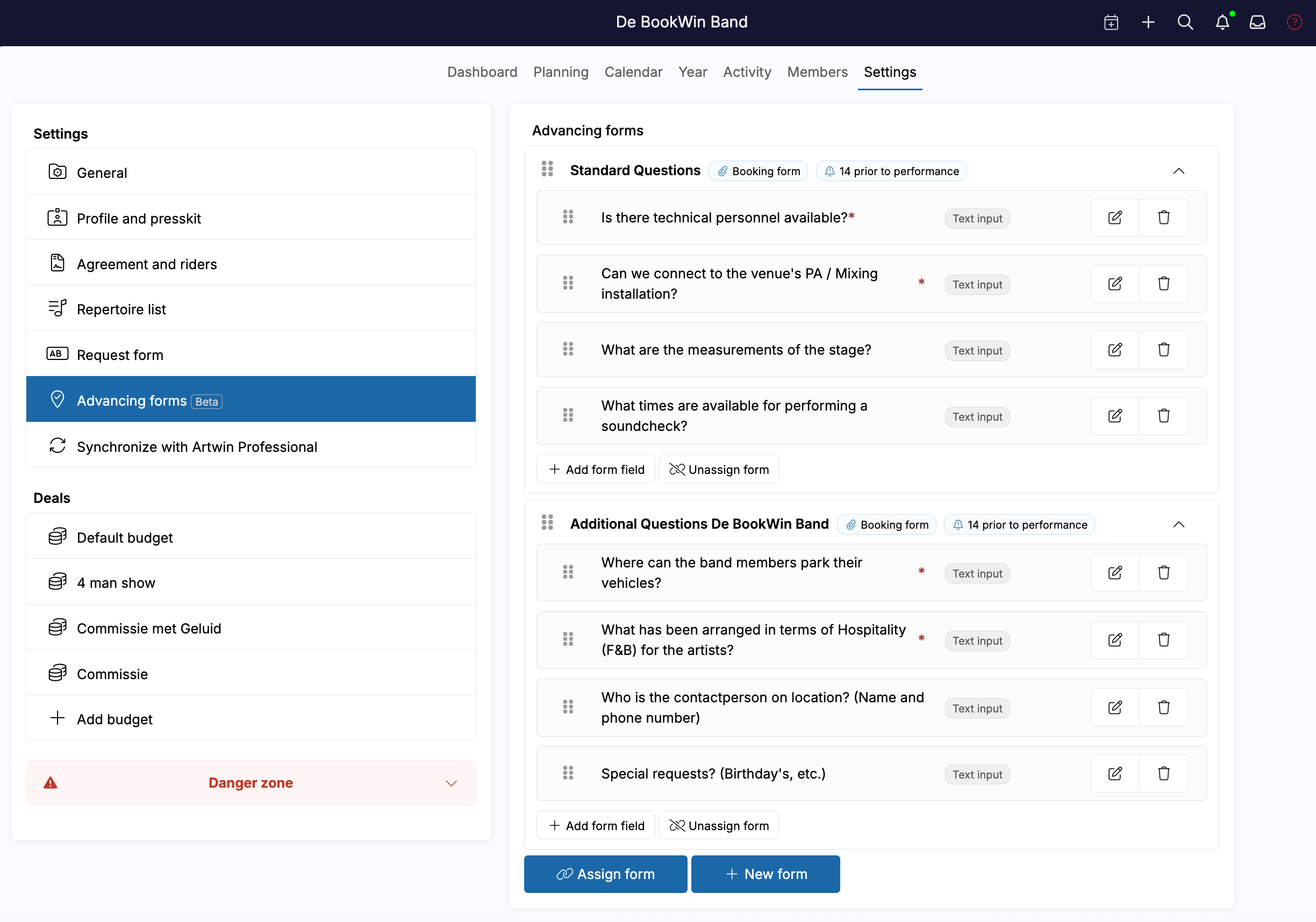
Within Artwin Live, advancing is directly connected to the booking itself. Per artist, you can define one or more standard advancing forms, including fixed questions, required fields and a predefined deadline, for example fourteen days before the show. As soon as a booking becomes confirmed, the correct form automatically appears within that booking.
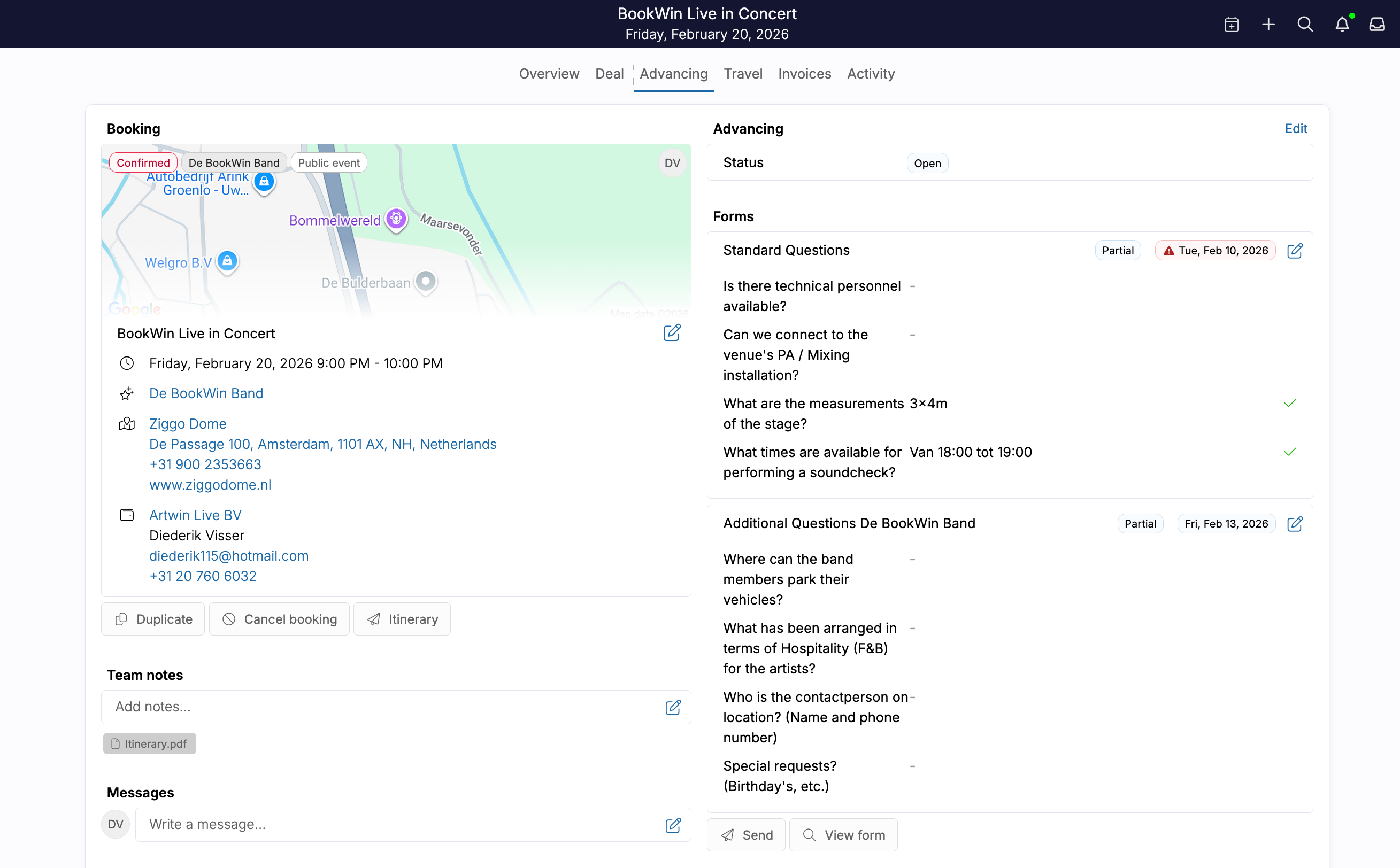
Agents can immediately see which information is still missing and which deadlines have passed. All answers remain connected to the specific show and can be confirmed once reviewed, making them visible to the artist and the wider team. This creates a central overview per tour, without relying on separate communication channels. The result is fewer reminders, less manual consolidation of information and significantly more calm in the final week before departure.
Case 2: A growing agency with multiple bookers
In a growing agency, several bookers manage different artists and performances. Each has their own working style. One sends out production requests immediately after the contract is signed, another waits until closer to the show. It may not always be clear who has sent out the advancing or which information has already been received.
This creates uncertainty within the team. Artists may receive incomplete information, managers need to double-check progress and duplicate work occurs because tasks are not centrally visible.
By making advancing a fixed part of the booking workflow, this dynamic changes fundamentally. In Artwin Live, advancing forms are not sent separately but are automatically linked to the relevant artist and booking. This ensures that every booker works within the same structure, without sacrificing flexibility.
Within the booking overview, it becomes visible which advancing tasks are still open and which deadlines have passed. Because everything is part of the same environment where contracts, budgets and invoices are managed, context is never lost. There is no separate list, no external document and no disconnected reminder system required.
This approach builds on decades of experience with Artwin Professional, where advancing was often organised manually. In Artwin Live, that practical knowledge has been translated into an integrated workflow where collaboration and clarity go hand in hand.
Why advancing often goes wrong
In many organisations, production information is treated as a separate step. The contract is signed, the invoice is sent, and advancing follows afterwards. That separation is precisely where fragmentation begins. When deadlines are not visible and information is not structurally linked to the booking, delays and confusion are almost inevitable.
By integrating advancing directly into the booking process, it becomes a logical continuation of the signed agreement. It is no longer dependent on individual discipline but supported by structure.
What a well-structured setup delivers
Agencies that organise advancing properly experience fewer last-minute emails and fewer mistakes on show day. Artists know earlier what to expect, managers have insight into the status of each performance and bookers no longer have to search through inboxes or spreadsheets for missing details.
Advancing is not an administrative formality. It is the bridge between agreement and execution. By standardising this process per artist and linking it directly to bookings, agencies gain predictability and control.
That is where the strength of an integrated platform such as Artwin Live becomes visible. Planning, contracts, finances and production are not separate modules, but connected parts of one coherent workflow.